
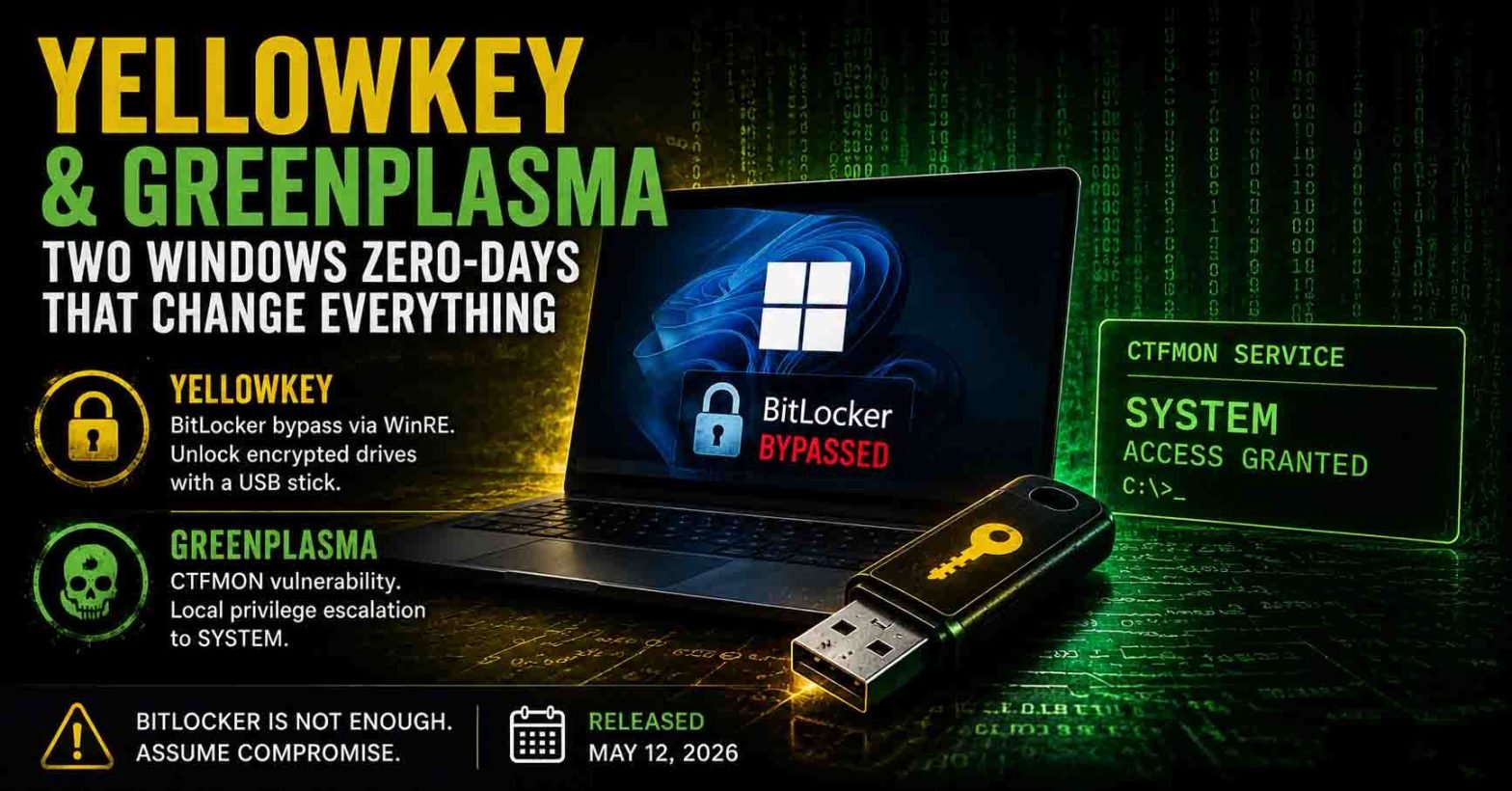
Last week, we wrote about YellowKey, the BitLocker bypass that turns a missing Windows 11 laptop into a data exposure event. The proof-of-concept is public, Microsoft has assigned CVE-2026-45585 (CVSS 6.8), and a full security update still has no committed ship date. Mitigation guidance exists, but the choice between Microsoft’s WinRE fix and BitLocker+PIN is not obvious, and the change-management work behind either one is real.
So we wrote it down in a white paper.
What’s in the white paper:
YellowKey BitLocker Bypass: A Practical Guide for Defenders is built for the people who actually have to make this call: security leaders, IT leaders, and compliance officers. It covers:
- The four standard risk treatments applied to YellowKey specifically, including when “Accept” is defensible and why “do nothing” is not the same thing
- A decision matrix by device class: servers, kiosks, unattended-boot workstations, office desktops, travel laptops, and high-value endpoints, with the recommended mitigation for each and the reasoning behind it
- Pros and cons of Microsoft’s WinRE mitigation, including the historical pain point that is reestablishing BitLocker trust for WinRE after modification
- Pros and cons of BitLocker+PIN, including the help-desk surge you should plan for in the first two weeks
- Change-management playbooks for both mitigations: before rollout, during rollout, and after rollout, with the specific verification steps that catch the failures we have seen on similar projects
- Detection signals for security operations teams, including the event IDs, file paths, and registry artifacts that indicate either exploitation attempts or a reverted mitigation after a Windows feature update
- Compliance implications under PCI DSS v4.0, the HIPAA Security Rule, CJIS, CMMC, and NIST SP 800-171, and state data breach notification statutes, with the specific control citations
Why we wrote this one:
YellowKey is unusual because the exploit is trivial, the control it defeats is the one most organizations point to for lost-device response, and the fix runs through WinRE, which has been a difficult servicing surface every time we have touched it. The conversations we have been having with clients since the disclosure all share the same shape: we know we need to do something, but what, and on which devices, and in what order, and how do we explain it to our auditor?
The white paper answers those questions in one place. It is written to be defensible in front of a QSA, an OCR investigator, a CJIS auditor, a state auditor, or a CMMC C3PAO, and to be operationally executable by the people doing the work.
Download it here:
The release is public and unrestricted. Share it with your team, your leadership, your auditor, and anyone else who needs to understand what a missing laptop means right now.
What Assura Continues to Do for Our Clients Operationally
For clients with our Managed SIEM/XDR service, our Security Operations Center has deployed custom detections to detect exploitation of this vulnerability.
If you’re an Assura client and need to discuss this immediately, schedule time with our Engagement Management team using the link we sent to clients via email on Thursday, May 21, 2026. Otherwise, your Virtual ISO or Concierge will discuss how the recommendations apply to your specific fleet and compliance posture during your next scheduled call.
The Assura Team