
Overview:
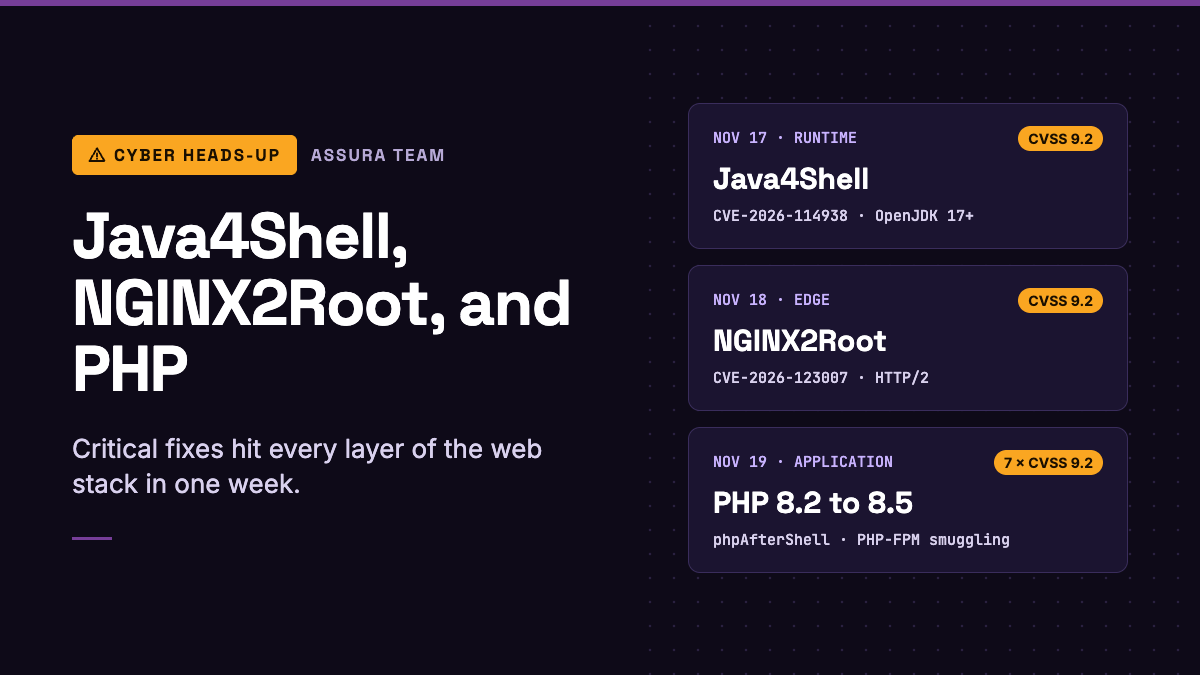
Another week, another set of vulnerabilities that affect the Internet’s “plumbing”. On November 17, Oracle and the OpenJDK project patched Java4Shell (CVE-2026-114938), a heap corruption bug in the JVM’s Base64 decoder. On November 18, F5 shipped fixes for ten NGINX vulnerabilities, led by two critical HTTP/2 remote code execution flaws, CVE-2026-123007 and CVE-2026-123633. On November 19, the PHP project released security updates for every supported branch, closing 17 advisories, seven of them rated Critical.
If you run Java application servers, anything sitting behind NGINX, or PHP sites (which covers most WordPress deployments), you have patching to do this week. Some environments are hit by two of these at once: NGINX in front of PHP-FPM is one of the most common hosting stacks on the internet.
As of November 19, none of these vulnerabilities is confirmed exploited in the wild, and none appears in CISA’s Known Exploited Vulnerabilities (KEV) catalog. That window will not stay open. Public proof-of-concept code already exists for the most widespread NGINX flaw, and CSIRT Italia reports a PoC for one of the PHP session bugs is available online.
| Issue | Key CVEs | Severity | Public PoC | Fixed In |
|---|---|---|---|---|
| Java4Shell (OpenJDK HotSpot) | CVE-2026-114938 | CVSS 4.0 9.2 (Calif); CVSS 3.1 8.1 (Oracle, OpenJDK) | Memory-corruption reproducer only; product exploits withheld | 17.0.21.1, 21.0.13.1, 25.0.5.1, 27.0.1.1, and 8u513-perf |
| NGINX2Root (NGINX HTTP/2) | CVE-2026-123007, CVE-2026-123633 | CVSS 4.0 9.2; CVSS 3.1 8.1 | Yes, for CVE-2026-123007 | NGINX 1.30.7 (stable), 1.31.9 (mainline); NGINX Plus 37.0.8.1, 37.3.0.1 |
| PHP November security release | CVE-2026-126714, CVE-2026-129289, CVE-2026-115560, and four more Critical | Seven rated CVSS 4.0 9.2 | Reported for CVE-2026-115560 | 8.5.13, 8.4.28, 8.3.37, 8.2.36 (and 8.6.0) |
What It Is:
Java4Shell (CVE-2026-114938):
Java4Shell is a bug in the code Java uses to decode Base64, one of the most common text formats on the web. A malformed string can corrupt the memory of a running Java application. At minimum, that crashes it. With enough product-specific work, it lets an attacker with no credentials run code on the server. It affects Java 17 and newer from every vendor, but only on servers with recent Intel or AMD processors that support a specific instruction set (AVX-512 VBMI). Standard Java 8 and 11 are not affected, and neither are ARM servers. Researchers at Calif demonstrated attacks against Keycloak, Jira Data Center, Confluence Data Center, Jenkins, and other widely used products.
For the technical deep dive, see Calif’s write-up and the Qualys analysis in the References below.
NGINX2Root (CVE-2026-123007 and CVE-2026-123633):
NGINX is the web server and reverse proxy sitting in front of a huge share of the internet’s websites and APIs. Two bugs in how it handles HTTP/2 let an attacker with no credentials corrupt memory and potentially run code on the server. The worse of the two, CVE-2026-123007, affects every NGINX release since 2015 that has HTTP/2 turned on, which is most of them. F5 fixed both on November 18, along with eight other NGINX flaws. A public exploit already exists, though it is difficult to pull off in practice.
F5’s advisories, along with the Wiz Research and Tenable write-ups in the References, cover the technical details.
PHP Security Release (November 19):
PHP runs most of the web’s content management systems, including WordPress. The November 19 release fixes 17 vulnerabilities across every supported version of PHP, and seven of them are rated Critical. The most serious can let an attacker run code on the server by abusing PHP’s default session handling, or by smuggling requests on sites where PHP-FPM sits behind certain proxy configurations. Two of the Critical bugs exist because last month’s emergency PHP fix did not close every path. If you patched in October, you still need this update.
The PHP ChangeLog and the individual PHP security advisories in the References list every CVE and its technical details.
Why These Are Dangerous:
- These are edge components. NGINX terminates TLS for a huge share of public websites and APIs. Xint counted 56.7 million NGINX hosts on Shodan, and 98.9% of those reporting a version fell in the range affected by CVE-2026-123007. Keycloak, PingFederate, Jira Data Center, and Jenkins sit at identity and DevOps chokepoints. Code execution on any of them is a foothold with valuable credentials nearby.
- Version numbers lie. Java runtimes are bundled in vendor products, appliances, and container images that never appear as “Java” in your software inventory. NGINX is embedded in ingress controllers, load balancers, and OpenResty. Linux distributions backport fixes without changing the upstream version string, so
nginx -vandphp -valone do not prove you are patched or exposed. - Availability is at risk before exploitation matures. Every one of these bugs can crash workers or the entire JVM long before an attacker gets reliable code execution. A crash loop on your SSO provider or your public web tier is an outage.
- Unsupported software gets no fix. PHP 8.1 and older receive nothing. NGINX Plus R33 through R36 have no patch, and customers on those releases must move to a 37.x build. The community Kubernetes ingress-nginx project was archived in March 2026 and has no release for these CVEs.
Assura’s Recommendations:
Patch internet-facing systems first, then work inward. For all three products, a config reload is not sufficient after an upgrade. Restart the service so the new binary or runtime is actually loaded.
Find Your Exposure:
Assura VMaaS clients do not need to do any active discovery. Finding affected assets is what we are here for. Our team is already scanning for all three issues and will contact you directly if any exposed systems are found. Your part is to apply the patches and restart the services.
Everyone else should start with an authenticated vulnerability scan (Tenable Vulnerability Management, Qualys VMDR, Rapid7 InsightVM, or similar) across the environment, starting with internet-facing systems. Hunting for runtimes and binaries host by host does not scale. A few caveats:
- Use credentialed scans or agents. An unauthenticated network scan will miss Java runtimes bundled inside products like Jira Data Center and Confluence Data Center, and it cannot see fixes that Linux distributions backport without changing the version number.
- Confirm your scanner has the checks. Vendors are still releasing detections for these CVEs this week. A clean result from a scanner that does not yet have the check tells you nothing.
- Scan container images, not just hosts. A vulnerable Java runtime or NGINX build baked into an image will not show up in a host scan.
- A scanner reports versions, not exposure. It will flag every Java 17 install regardless of CPU, and it will not know whether HTTP/2 is enabled or whether PHP-FPM reuses connections. Use the spot checks under each product below to confirm exposure on systems you cannot patch right away.
- Rescan after restarting. A scan can report a host as patched once the package updates, while the old binary or JVM keeps running until the service restarts.
Java4Shell:
- Update every Java 17, 21, 25, and 27 runtime to 17.0.21.1, 21.0.13.1, 25.0.5.1, or 27.0.1.1 (or your vendor’s equivalent build). Oracle Java SE 8 Performance Pack users move to 8u513-perf. Amazon Corretto shipped 17.0.21.1.2 on November 17, and Red Hat’s fixed RPMs carry the same
.1fourth field (for example,java-17-openjdk-17.0.21.1.2). Check Temurin, Zulu, Microsoft, Debian, and Ubuntu advisories for your exact build, since some distribution packages were still pending as of November 18. - Chase the bundled runtimes. Jira Data Center, Confluence Data Center, Artifactory, Keycloak containers, and many appliances ship their own JRE. Watch for vendor updates and rebuild container images from patched base images.
- Spot-check the hardware condition on Linux. All four flags must print for the host to be affected:
grep -m1 '^flags' /proc/cpuinfo | tr ' ' '\n' | grep -E '^(avx512f|avx512bw|avx512vbmi|bmi2)$'- If you cannot patch today, disable the vulnerable intrinsic and restart the JVM. Java falls back to its standard decoder. Test first if your application decodes large volumes of Base64. The alternative,
-XX:UseAVX=2, has a broader performance cost and will stop an ARM JVM from starting, so use it only on x86-64.
# Add to the service's JVM options, or set for the service environment:
JAVA_TOOL_OPTIONS="-XX:-UseBASE64Intrinsics"

# Verify on the running process (not just the installed package):
jcmd <pid> VM.version
jcmd <pid> VM.flags -all | grep UseBASE64Intrinsics- Do not rely on a reverse proxy or input-size limits. The trigger string is short, and Calif found that NGINX request buffering does not stop the exploit chains in general.
NGINX:
- Upgrade NGINX Open Source to 1.30.7 (stable) or 1.31.9 (mainline), or install your distribution’s fixed package. NGINX Plus customers move to 37.0.8.1 or 37.3.0.1. R33 through R36 have no patch.
- Restart, do not reload. A reload re-reads configuration but keeps the old binary running.
# Spot-check: version, and whether HTTP/2, HTTP/3, the resolver, or mail proxy is in use
nginx -v
nginx -T 2>/dev/null | grep -nE 'http2|http3|quic|resolver|mail \{'

# After upgrading
sudo systemctl restart nginx- If you cannot patch today, disable HTTP/2 on exposed listeners. This blocks CVE-2026-123007 and CVE-2026-123633 only. It does nothing for the HTTP/3, resolver, or mail proxy bugs, so treat it as a stopgap and re-enable HTTP/2 after upgrading.
server {
    listen 443 ssl;    # remove "http2" from listen directives
    http2 off;         # NGINX 1.25.1 and later
    ...
}

sudo nginx -t && sudo systemctl reload nginx
# Confirm old worker processes have exited
ps -o pid,lstart,cmd -C nginx- Remove HTTP/3 (QUIC) listeners until patched to cover CVE-2026-121810. Bind mail proxy listeners to loopback or firewall them for CVE-2026-113425. Point
proxy_passat a fixed upstream group instead of a request-derived hostname for CVE-2026-123634. - Kubernetes: The archived community ingress-nginx controller will not get a fix. Disable HTTP/2 in the controller ConfigMap now and put migration to a supported controller on the calendar. F5’s NGINX Ingress Controller, OpenResty, and other NGINX-based products need updates from their own vendors.
# ingress-nginx controller ConfigMap
data:
use-http2: "false"- Block the SCTP kernel module on Linux hosts that do not use it. Xint used an unpatched SCTP flaw to escalate from the NGINX worker to root.
echo "install sctp /bin/false" | sudo tee /etc/modprobe.d/disable-sctp.conf
lsmod | grep sctp    # if loaded, unload or reboot after confirming nothing depends on it
PHP:
- Upgrade to 8.5.13, 8.4.28, 8.3.37, or 8.2.36, then restart PHP-FPM. The official
phpDocker images already have fixed tags. As of November 19, Ubuntu, Debian, SUSE, and Amazon Linux 2023 packages were still pending, so check your distribution’s tracker rather than trustingphp -v. - Get off PHP 8.1 and older. They receive no fix. PHP 8.2 reaches end of life on December 31, 2026, so plan that migration now too.
- If you use managed WordPress or shared hosting, ask your provider when PHP will be updated on your plan. You cannot patch what you do not control.
- Interim hardening while you wait. None of these replace the upgrade. Check the FPM pool configuration, not just the CLI, since they often differ.
# Check current settings (repeat against each FPM pool's php.ini)
php -i | grep -E 'session.save_handler|session.upload_progress.enabled|zend.exception_ignore_args'

# php.ini or FPM pool overrides
session.upload_progress.enabled = Off   ; unless you actually use upload progress
zend.exception_ignore_args = On         ; PHP 8.5

# Find FastCGI connection reuse in front ends (CVE-2026-129289)
grep -rn "fastcgi_keep_conn" /etc/nginx/
grep -rni "enablereuse" /etc/httpd/ /etc/apache2/ 2>/dev/null
#   NGINX:  fastcgi_keep_conn off;   (the default)
#   Apache: enablereuse=off

# Find catch_workers_output (CVE-2026-129291)
grep -rn "catch_workers_output" /etc/php/ /etc/php-fpm.d/ /usr/local/etc/php-fpm.d/ 2>/dev/null- Normalize URL schemes in code. Lowercase
httpsandftpsschemes and validate redirect targets until patched to address CVE-2026-128064, where mixed-case URLs can send data in plaintext.
WAF and CDN Protection:
A WAF helps with some of these and does almost nothing for others. Use it to buy time, not as a substitute for patching.
- Java4Shell: partial coverage. Cloudflare has released six managed rules that flag malformed Base64 in headers, query strings, request bodies, path segments, JWTs, and WebAuthn values. They are available on Pro, Business, and Enterprise plans and only log by default, so review the matches and switch them to Block once you confirm they are not legitimate traffic. A WAF will not see Base64 wrapped in another encoding or compressed, traffic over non-HTTP protocols such as Kafka, internal service-to-service traffic, or the client-side attack where a Java program connects out to a malicious server.
- NGINX2Root: signature rules will not catch it. Every HTTP/2 frame in the attack is valid on its own, so a WAF that inspects requests or frames has nothing to match, and Cloudflare says these flaws cannot be reliably matched by a rule. A WAF module running inside NGINX, such as ModSecurity, does not help either, because the bug sits in NGINX’s HTTP/2 handling before the module ever sees the request. What does help is architecture: a CDN, WAF, or load balancer that terminates HTTP/2 and opens its own connection to NGINX keeps attackers away from the vulnerable code, but only if NGINX cannot be reached directly. If your NGINX server is itself the load balancer or reverse proxy, or your front end uses TLS passthrough, it is exposed. Lock the origin down so it accepts connections only from your CDN or WAF.
- PHP: two of the seven Critical CVEs. AWS WAF’s PHP Managed Rule Group version 2.6 covers CVE-2026-115560 (session upload progress) and CVE-2026-129289 (PHP-FPM request smuggling), in Count mode by default. AWS published no rules for the other five, including phpAfterShell, because the attack traffic looks like normal requests or depends on server state a WAF cannot see. Cloudflare’s rules for this release also run in log mode and do not cover phpAfterShell.
- Watch your provider’s changelog. Vendors are still adding coverage this week. Whenever a rule defaults to log or count mode, review the matches before switching it to block mode.
Detection Signals:
No vendor or researcher has published post-exploitation IOCs for these vulnerabilities. Watch for the behavior that precedes or follows a successful attempt:
- Crash patterns: Unexpected JVM crashes on internet-facing Java services (look for new
hs_err_pid*.logfiles), NGINX workers exiting on signal 11 or 6, and PHP-FPM children exiting onSIGSEGV. Repeated crashes on one service are a strong signal someone is grooming the heap. - Java4Shell input patterns: Bursts of
IllegalArgumentExceptionfromjava.util.Base64in application logs, especially against long strings of a repeated character ending in=. - NGINX2Root traffic: Long-lived HTTP/2 connections from a single source moving abnormal volumes of data or carrying an unusual number of
WINDOW_UPDATEframes. The public PoC needs roughly 128 GB over one connection, so volume anomalies stand out. - Process lineage:
java, an NGINX worker, orphp-fpmspawningsh,bash,cmd.exe,powershell.exe,curl, orwget, or making new outbound connections. - Inventory drift: Java runtimes or NGINX binaries on hosts that are not in your asset inventory.
# Recent JVM crash logs
find / -name 'hs_err_pid*.log' -mtime -3 2>/dev/null

# NGINX worker crashes
grep -E "exited on signal (6|11)" /var/log/nginx/error.log*

# PHP-FPM child crashes
journalctl --since "3 days ago" | grep -E "php.*fpm.*exited on signal (6|11)"
What Assura is Doing for Our Clients:
- Vulnerability Management as a Service (VMaaS) clients: You do not need to run your own discovery. That is our job, and we are matching all three advisories against your scan results now. If you have affected assets, our team will contact you directly with the asset list and the fixed version for each, prioritizing internet-facing systems.
- Managed SIEM/XDR clients with vulnerability data ingested: Your vulnerability data feeds the detection engine in Stellar Cyber Open XDR. When a detection fires on a host that carries CVE-2026-114938, CVE-2026-123007, CVE-2026-123633, or one of the Critical PHP CVEs, it is automatically enriched with that context, so our analysts know right away that the host is exposed and can prioritize accordingly.
Enriched detections speed up triage. They do not close the hole. Patch.
If you’re an Assura client, reach out to your Virtual ISO or Concierge. Otherwise, contact us via the form on our website.
References:
- Calif: Java4Shell: Write once, RCE everywhere
- CISA: Critical Java Vulnerability Requires Immediate Patching
- NVD: CVE-2026-114938
- Qualys: How to Find, Mitigate, and Patch the Critical Java4Shell Flaw
- F5 K000164058: Out-of-band Security Notification (November 18, 2026)
- F5 K000163926: NGINX ngx_http_v2_module vulnerability CVE-2026-123007
- nginx.org: Security Advisories
- Wiz Research: Unauthenticated Remote Code Execution in NGINX
- CERT-EU Security Advisory 2026-022: Critical Vulnerabilities in Nginx
- Tenable: NGINX2Root FAQ
- PHP.net: 2026 Release Announcements
- PHP.net: PHP 8 ChangeLog
- PHP Security Advisory GHSA-fm2m-fjf5-v3cp (CVE-2026-126714)
- PHP Security Advisory GHSA-qc49-hpvq-g2w6 (CVE-2026-129289)
- Cloudflare: How Cloudflare WAF Helps Protect Against Java4Shell (CVE-2026-114938)
- AWS Security Bulletin 2026-190-AWS: PHP Foundation Security Releases