
Business Continuity and Continuity of Operations (COOP)
When disruption hits, the organizations that keep running are the ones that planned to. Assura builds the plans, trains your people, and tests your readiness so your critical operations survive a cyberattack, a natural disaster, a facility loss, or any other event. In government this discipline is called Continuity of Operations, or COOP. In the private sector it is business continuity planning.
Prepare for the worst before it arrives.
Every organization faces disruption eventually: a ransomware attack, a severe storm, a key vendor failure, a pandemic. The question is not whether an event will come, but whether you will keep operating when it does. Continuity is not solely an IT initiative. It is a whole-organization responsibility, from the leaders who declare a disaster to the staff who execute the recovery. Assura builds continuity programs that work when it counts and hold up under examination.
What business continuity planning covers.
Business continuity planning prepares your entire organization to respond to and recover from disruption. Government and quasi-governmental organizations often know this as Continuity of Operations, or COOP. It is broader than IT recovery: your IT Disaster Recovery plan is a supporting plan within the continuity architecture, not the whole program. A complete continuity program spans four areas.
Program foundation.
We start with the analytical groundwork: a Business Continuity policy, a Business Impact Analysis that sets your Recovery Time and Recovery Point Objectives, a continuity risk assessment, and a recovery strategy gap analysis. Every plan that follows is driven by what this reveals.
Recovery plans.
We develop the plans your organization actually needs, from Crisis Management and Emergency Response to an organization-wide Business Continuity plan and Department Recovery plans. Each one covers the full crisis lifecycle, from notification through return to normal operations.
Training and exercises.
A plan no one has practiced fails under stress. We train your people on their roles and validate every plan through tabletop, functional, and full-scale exercises.
Ongoing maintenance.
A stale plan is a liability. We keep your program current through annual reviews and maintenance built into every plan, so it stays accurate and audit-ready.
Why all-hazards planning.
Some firms build continuity plans around a short list of anticipated threats. That approach breaks the moment something unanticipated happens. Assura uses an all-hazards approach: we establish one unified program foundation with common command structures, notification procedures, and decision-making frameworks that work regardless of what caused the disruption. Where a specific high-priority threat warrants dedicated planning, such as a major cyber event or an extended facility loss, we add a threat-specific annex that builds on the base program rather than duplicating it.
Comprehensive coverage.
One foundation keeps your program effective against events you never saw coming, whether a cyberattack, severe weather, or a leadership crisis.
Efficiency.
Your people learn one set of procedures and one command structure, instead of maintaining a separate plan for every threat.
Scalability.
As new risks emerge, the all-hazards foundation absorbs them without a program rebuild.
Audit defensibility.
Auditors recognize all-hazards as the professional baseline. A program built this way is defensible across multiple frameworks.
Every continuity program we build is backed by our AuditArmor® Guarantee. If your audit reveals non-compliant work Assura performed, we fix it at our expense, no matter the cost.
How we build your program.
Assura’s methodology is grounded in the professional planning practices of DRII and organized around three phases that move from program foundation through full operational integration. A dedicated planner guides your organization through each phase, with all activities tracked in a Continuity Planning Roadmap tailored to your specific risks and recovery requirements.
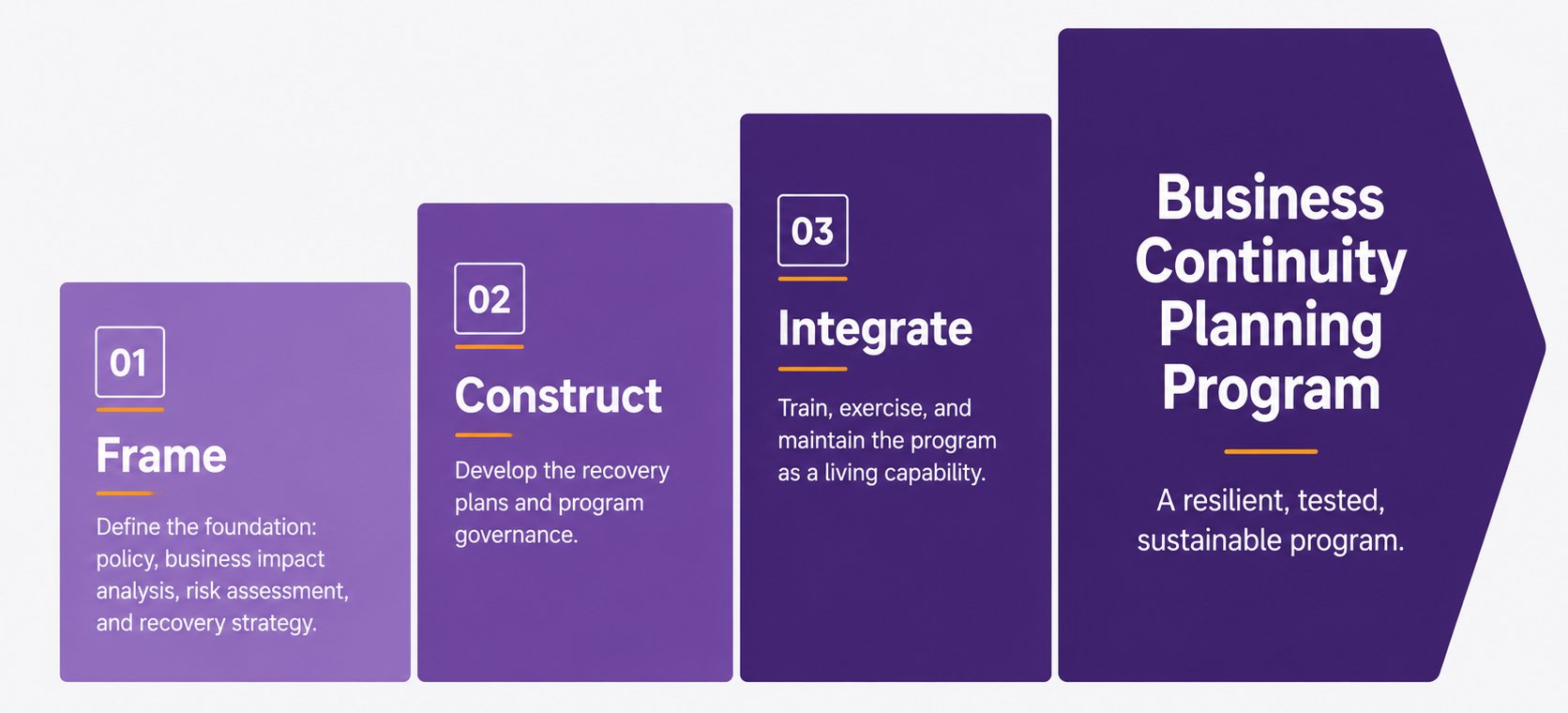
Phase 1: Frame
We establish the analytical and strategic foundation of your program: Business Continuity policy, Business Impact Analysis (BIA), all-hazards risk assessment, and a recovery strategy gap analysis across people, processes, technology, facilities, and data. Every plan that follows is driven by what this phase reveals.
Phase 2: Construct
We translate the analysis and strategy outputs from Phase 1 into formal recovery plans and program governance documentation, developed collaboratively with your subject matter experts and leadership. Assura develops the plans; your organization validates, approves, and owns them.
Phase 3: Integrate
We make the program a living organizational capability: training your people on their specific roles, validating plans through tabletop, functional, and full-scale exercises, and sustaining the program through structured annual maintenance so it stays accurate and audit-ready over time.
Who we work with.
Leaders accountable for the outcome.
You are answerable to a board, an auditor, a regulator, or a cyber insurer who wants to see a real, tested continuity capability, not a binder on a shelf. You need a program that demonstrably works and that stands up under examination. We build it, document it, and defend it.
Security and program leaders.
You are building or maturing a resilience program with limited internal bandwidth. You want a partner who knows the professional practices, integrates continuity with your broader security program, and moves your maturity forward year over year without adding headcount.
Focused specifically on recovering IT systems and data? Our IT Disaster Recovery planning service goes deep on system recovery, RTO and RPO, and DR testing. Business continuity and IT disaster recovery work best together, and we deliver them either as one integrated engagement or as separate services.
Built to work with what you already have.
If you already have continuity artifacts, a Business Impact Analysis, an IT risk assessment, an IT Disaster Recovery plan, we use them. We don’t redevelop work that already meets program requirements.
For clients enrolled in GRC-as-a-Service, key artifacts are already on file, so your continuity program starts further down the road. Your IT Disaster Recovery and Incident Response plans integrate as supporting plans within the continuity architecture.
- Business Impact Analysis (BIA)
- IT risk assessments
- IT Disaster Recovery plan
- Incident Response plan
- Existing continuity plans or policy documents
- GRC-as-a-Service program artifacts
Two ways to engage.
Continuity planning is not one-size-fits-all, and neither is how you buy it. Whether you need a bounded project or an ongoing managed partner, we structure the engagement around your organization’s needs.
Project Engagement
A defined, bounded engagement for a specific need: a one-time program build, a single plan, or an exercise. Ideal when you have a clear requirement or want to establish a foundation you will maintain yourself.
Continuity Planning-as-a-Service (CPaaS)
An ongoing managed program with a dedicated planner, an annual Roadmap, and a capability that matures year over year. Ideal when you want an expert to own the program so your team can focus on its mission.
Prepare for the worst. With the best.
Whether you are starting from nothing or maturing an existing program, Assura builds continuity capabilities that work when it counts and hold up when an auditor asks. Talk to our team about a Project Engagement or Continuity Planning-as-a-Service, and see what a real continuity program looks like.
Frequently Asked Questions
What is the difference between business continuity and disaster recovery?
Business continuity is the broad discipline of keeping your whole organization operating through a disruption, covering people, processes, facilities, and technology. IT Disaster Recovery is one supporting plan within that broader program, focused specifically on restoring IT systems and data. In other words, disaster recovery is a component of business continuity, not a synonym for it.
Is business continuity the same as Continuity of Operations (COOP)?
Yes. Continuity of Operations, or COOP, is the term government and quasi-governmental organizations use for what the private sector calls business continuity planning. The discipline is the same: ensuring essential functions continue during and after a disruption.
What frameworks require a business continuity or COOP plan?
Many do. Business continuity and contingency planning are required or expected by NIST SP 800-34, NIST SP 800-53, the NIST Cybersecurity Framework, ISO 22301, HIPAA, SOC 2, CMMC, PCI DSS, FFIEC, CJIS, IRS Publication 1075, and FISMA, among others. The specific requirements vary by framework, and Assura builds programs that satisfy the standards that apply to you.
How long does it take to build a continuity program?
It depends on the size and complexity of your organization and how much usable documentation already exists. A focused effort for a single-site organization can take a few weeks, while a multi-site or highly regulated environment takes longer. If you already have artifacts such as a Business Impact Analysis or an IT risk assessment, we use them rather than starting over, which shortens the timeline.
What is all-hazards continuity planning?
All-hazards planning means your continuity program prepares your organization to respond to any type of disruption, whether it is a cyberattack, a natural disaster, a facility loss, a pandemic, or a key vendor failure, rather than planning for one scenario at a time. It focuses on maintaining essential functions regardless of what caused the interruption.
Do you offer ongoing continuity management, or only one-time projects?
Both. You can engage Assura for a discrete project to build or refresh your continuity program, or you can choose Continuity Planning-as-a-Service (CPaaS), an ongoing managed engagement with a dedicated planner who maintains your program, runs exercises, and keeps your documentation current and audit-ready year-round.