
Incident Response Planning
When an incident hits, the plan you have on paper is the plan you execute under pressure. Assura builds your incident response plan, then tests it through realistic exercises, so you find the gaps in a controlled setting instead of during a live breach. The result is a documented, exercise-proven plan your team can execute with confidence and defend to any auditor.
Most incident response plans fail their first real test.
Most organizations fall into one of two camps. Either they have no documented incident response plan at all, or they have one that was written to satisfy an auditor, filed away, and never tested. Both fail the same way.
When an incident hits, an untested plan reveals its gaps at the worst possible moment. Contact lists are out of date. Roles are unclear. The escalation path assumes someone who left the company a year ago. Steps that looked complete on paper turn out to be missing the detail your team needs when the pressure is real and the clock is running.
The plan is not the deliverable. A plan your team can actually execute under pressure is the deliverable, and the only way to know you have one is to test it before you need it.
What we deliver
An Assura incident response engagement produces more than a document. You get a plan built to a recognized standard, playbooks your team can follow under pressure, exercises that prove the plan works, and an after-action report that turns what you learned into concrete improvements.

The Incident Response Plan
A documented incident response plan built to the NIST SP 800-61 lifecycle: preparation, detection and analysis, containment, eradication, recovery, and post-incident activity. Roles, responsibilities, escalation paths, communication procedures, and legal and regulatory notification obligations are all defined and current, mapped to the frameworks you answer to.

Incident Playbooks
Scenario-specific playbooks for the incidents most likely to hit your environment, such as ransomware, business email compromise, data exfiltration, and insider threat. Each playbook gives your team the specific steps to take when that scenario is unfolding, so responders are not improvising under pressure.

Response Exercises
We test the plan through exercises that range from tabletop discussions to full-scale and purple team simulations, so you learn where it breaks in a controlled setting instead of during a real breach.

After-Action Report
After every exercise, you get a documented after-action report: what worked, what broke, and specific, prioritized recommendations to close the gaps. This is the artifact that proves to an auditor you tested the plan, and the roadmap that makes the plan stronger before the next exercise or the next real incident.
Nearly every cybersecurity framework, regulation, and standard requires a documented incident response plan, and a growing number require evidence that you have tested it. We build and test your plan to align with the frameworks that govern your organization, so the plan satisfies the requirement and the after-action report proves it.
How an engagement works
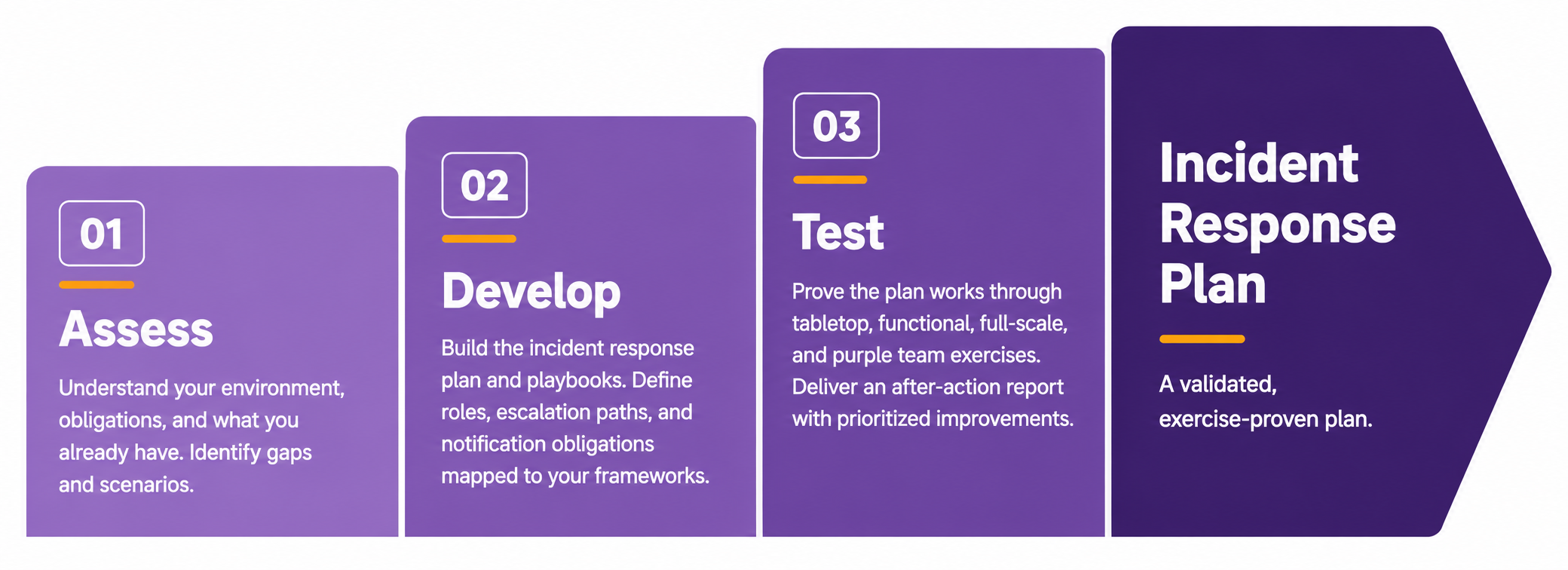
Every engagement follows the same disciplined path, whether we are building your plan from scratch or testing a plan you already have.
Two ways to engage
Whether you are starting from nothing or you have a plan that has never been put to the test, there is a path that meets you where you are.
Build and Test
Start from the ground up. We assess your environment, develop your incident response plan and playbooks, and then prove them through exercises, culminating in an after-action report. The right choice when you have no plan, or a plan so out of date that starting fresh is faster than fixing it.
Test an Existing Plan
Already have a plan? We put it to the test. We assess the plan you have, whether Assura wrote it or not, then exercise it through tabletop, functional, full-scale, or purple team scenarios and deliver an after-action report showing where it holds and where it breaks. The right choice when you have a documented plan but have never confirmed it actually works.
Who we work with
Incident response planning matters most to the people who will answer for it, whether that is to an auditor, a board, or their own team in the middle of a crisis.
You answer for what happens when an incident hits
You are accountable for proving to auditors, regulators, and your board that the organization was prepared. You do not want to explain after a breach that the plan existed but had never been tested. A documented, exercise-proven incident response plan, with an after-action report to show for it, is the evidence that the organization took its obligations seriously before anything went wrong.
You know a plan on a shared drive is not the same as readiness
You want your responders to have tested their playbooks against realistic scenarios, found the gaps, and closed them, so that when a real incident comes, muscle memory takes over instead of improvisation. You have the security knowledge to run this yourself, but not the time or the objective outside perspective to design and facilitate the exercises well.
Why Assura
Plenty of firms will hand you an incident response plan. Fewer will prove it works, and fewer still will stand behind it.
We test, we don't just document
Anyone can write a plan. We put yours through exercises that range from tabletop discussions to full-scale and purple team simulations, so you learn where it breaks in a controlled setting instead of during a real breach. The test is the point, not an afterthought.
We facilitate, your team performs
During an exercise, we design the scenario, inject the events, and evaluate how your team performs against your own plan. Your team executes the response. We run the exercise, then deliver an after-action report. You are building your own team’s readiness, with our objective assessment of how they did.
Built to the standard, mapped to your frameworks
Every plan is built to the NIST SP 800-61 lifecycle and mapped to the specific frameworks your organization answers to, so the plan is both operationally sound and audit-ready from day one.
The work we perform is backed by the AuditArmor® Guarantee. If your audit reveals non-compliant work Assura performed, we fix it at our expense, no matter the cost. That is the AuditArmor® Guarantee.
Want this owned and maintained for you? Incident response plan development, annual testing, and after-action reporting are all included in the Managed and Advanced tiers of GRC-as-a-Service. Instead of re-engaging each year, your plan stays current, gets tested annually, and is kept audit-ready as part of an ongoing program, with the same AuditArmor® Guarantee on the work.
Find out if your plan holds up.
Whether you need an incident response plan built from the ground up or you want to test the one you already have, Assura will make sure your team is ready before a real incident puts it to the test.
Frequently Asked Questions
What is the difference between an incident response plan and a disaster recovery plan?
An incident response plan governs how your team detects, contains, and recovers from a security incident, such as a ransomware attack, a data breach, or an intrusion. It is focused on the active response: who does what, in what order, while the incident is unfolding.
A disaster recovery plan governs how you restore IT systems and data after a disruption, whether that disruption is a cyberattack, a hardware failure, a natural disaster, or human error. It is focused on getting systems back online and meeting your recovery time and recovery point objectives.
The two overlap during a cyberattack, because a serious incident can trigger disaster recovery. But they answer different questions. Incident response answers "how do we stop this and limit the damage?" Disaster recovery answers "how do we get back to operational?" Most frameworks expect you to have both, and Assura builds both. If you need the recovery side, see our IT Disaster Recovery Planning service.
How often should we test our incident response plan?
At least annually, and after any significant change to your environment, your team, or your systems. Annual testing is the baseline that most frameworks expect, and some require it explicitly. PCI DSS Requirement 12.10.2, for example, mandates that you test your plan at least once a year and keep documentation to prove it.
Annual is the floor, not the ceiling. A plan goes stale faster than most organizations expect. People change roles, vendors change, systems get replaced, and contact lists drift out of date. If you have had meaningful turnover, migrated critical systems, or adopted a new technology stack since your last test, the plan should be exercised again regardless of where you are in the annual cycle.
The organizations that respond well to real incidents are the ones that treat testing as routine, not as a once-a-year compliance task. Each exercise surfaces something the last one missed, which is exactly why the after-action report matters as much as the test itself.
What kinds of testing exercises do you run?
We run the full range, matched to your team's maturity and what you need to prove.
Tabletop exercises are facilitated, discussion-based walkthroughs. Your team talks through how they would respond to a scenario, step by step, which surfaces gaps in roles, communication, and decision-making without touching production systems. This is often the right starting point.
Functional exercises go further. Your team actually executes parts of the plan, testing whether the runbooks, tools, and procedures work in practice rather than just on paper.
Full-scale exercises simulate a real incident end to end, testing the whole response under realistic conditions and time pressure.
Purple team exercises pair a controlled offensive test with your team's response, so the plan is exercised against realistic adversary behavior rather than a hypothetical scenario. This is the most demanding option, and the most revealing, because a live simulated attacker does not follow your script.
In every case, we design and facilitate the exercise, inject the events, and evaluate how your team performs against your own plan. Your team executes the response. We run the exercise, then deliver an after-action report.
Can you test a plan we already have, even if Assura did not write it?
Yes, and we do it regularly. If you already have a documented incident response plan, whether you wrote it internally or another firm built it, we can put it to the test. We assess the plan, design exercises around it, run your team through realistic scenarios, and deliver an after-action report showing where it holds up and where it breaks.
This is often the fastest way to find out whether the plan you are relying on actually works. Many organizations have a plan that satisfied an auditor on paper but has never been exercised, and the test is where the gaps surface. If the exercise reveals that the plan needs significant work, we can help rebuild it, but plenty of clients start by testing what they already have.
Does Assura respond to active incidents, or only build and test the plan?
This service is focused on building and testing your incident response plan, so your own team is ready to respond when an incident hits. The plan we build is the plan your team executes.
Hands-on incident response, where Assura takes an active role during a live incident, is available to clients engaged at the Advanced tier of GRC-as-a-Service or the Shield tier of Managed SIEM/XDR. If active response is something you want on the table, those are the engagements that include it, and we are happy to talk through how they work.
For everyone else, the value here is preparation. A documented, tested plan and a team that has practiced it is what determines how well you respond, and that is what this service delivers.