
IT Disaster Recovery Planning
When systems go down, recovery is not improvised, it is planned. Assura builds and tests the IT Disaster Recovery plans that get your critical systems and data back online within the timeframes your organization requires. Your IT DR plan is the technical backbone of your broader continuity program, and we make sure it holds up when you need it and when an auditor asks for it.
Most organizations believe they can recover from an IT disaster until they try. Backups go untested, recovery steps live in one person’s head, and the plan, if it exists, was written years ago for systems that have since changed. Then an outage, a ransomware event, or a failed data center turns an assumption into a crisis. A real IT Disaster Recovery plan removes the guesswork: it defines what must come back, how fast, in what order, and who does it, and it proves all of that before the disruption, not during it.
What IT Disaster Recovery planning covers.
IT Disaster Recovery is the discipline of restoring your technology, your systems, applications, and data, after a disruption. It is the technical layer beneath business continuity: where your business continuity program keeps the whole organization running, IT DR gets the technology back. A complete IT DR plan spans four areas.

Recovery objectives
Every critical system gets a Recovery Time Objective and a Recovery Point Objective: how fast it must return and how much data loss is tolerable. These numbers, grounded in a Business Impact Analysis, drive every other recovery decision.

Recovery procedures
A command-and-control plan that says who declares a disaster and who does what, paired with system-by-system recovery procedures detailed enough to execute under pressure, not vague guidance that assumes the expert is available.

Dependencies and sequence
Systems do not recover in isolation. A dependency analysis maps what must come back before what, so recovery follows the right order instead of stalling when a restored application cannot find the database it needs.

Testing and proof
A plan that has never been exercised is a hypothesis. Tabletop exercises validate the decisions and roles, and full-scale functional exercises prove actual recoverability, which is what a mature program and a demanding auditor both require.
CJISCMMCFFIECFedRAMPFISMAGLBAGovRAMPHIPAA/HITECHIRS 1075ISO 27031NIST CSFNIST SP 800-34NIST SP 800-53PCI DSSSOC 2SOXState-level Requirements
How we build a plan that works.
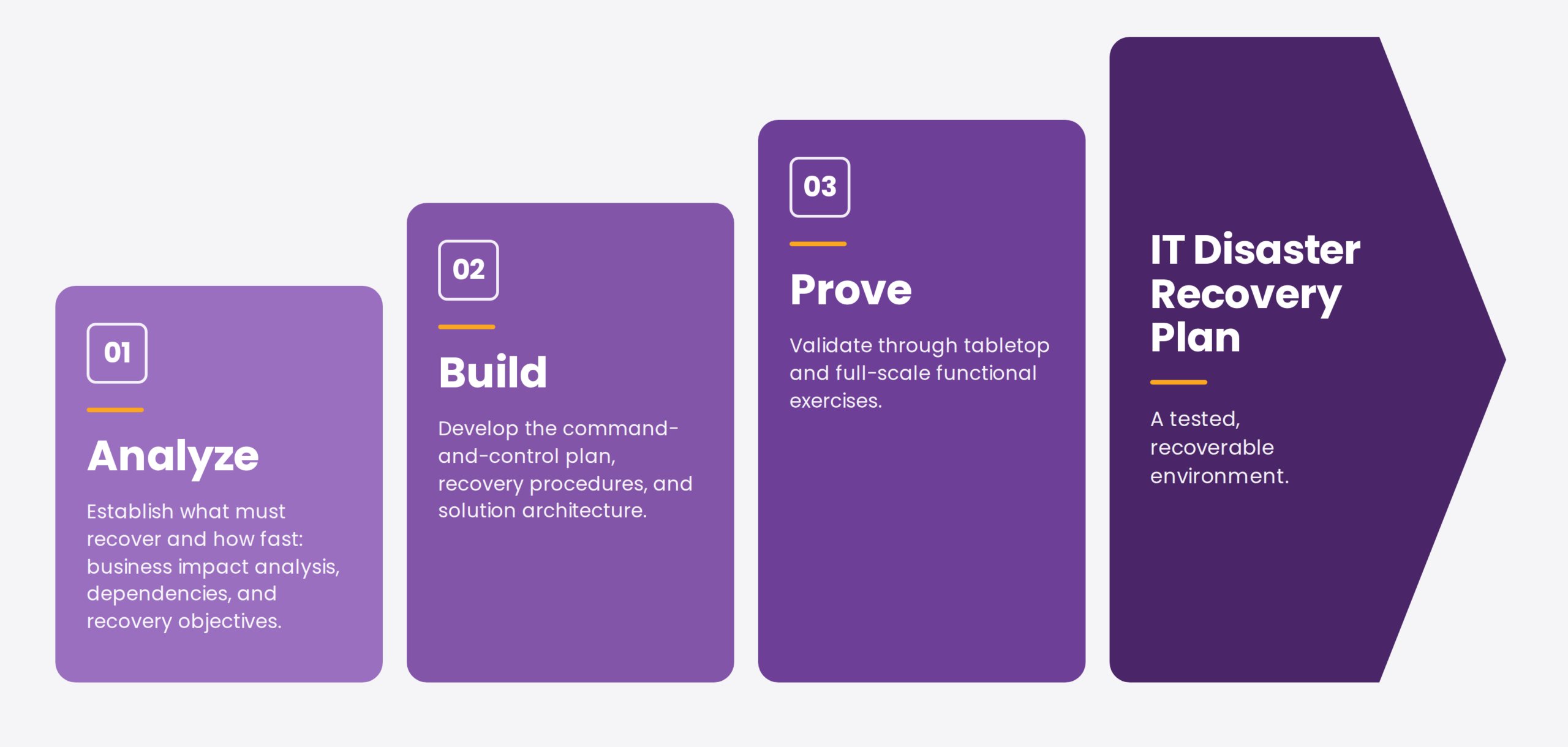
Our approach follows the DRI International Professional Practices for Business Continuity Management, the recognized professional standard for this discipline, and aligns to NIST SP 800-34 and ISO 27031. We move through three phases: analyze what matters, build the plan and procedures, and prove they work.
Analyze
We establish what must recover and how fast. If you do not already have them, we produce a Business Impact Analysis where Recovery Time Objectives and Recovery Point Objectives are defined, a system inventory, and a dependency analysis.
Build
We write the command-and-control plan and the supporting system recovery procedures, and where needed help you select an alternate processing site or architect a recovery solution. The result is a plan detailed enough to execute under pressure and defensible enough to satisfy an auditor.
Prove
We validate the plan through exercises: a tabletop to test decisions and roles, or a full-scale functional exercise that proves actual recovery and failback. Testing turns a document into a capability, and it produces the evidence auditors increasingly demand.
Who this is for.
IT and infrastructure leaders
You own recovery when it happens. We help develop a plan your team can actually execute, with clear procedures and proven recovery steps, so a bad day does not depend on one person’s memory or a scramble to improvise.
Security and program leaders
IT DR is a required component of a mature security program. We deliver it aligned to the frameworks you answer to, integrated with your incident response and continuity plans, and defensible under review.
Executives accountable for audits
A missing or untested recovery plan is an audit finding and an uninsurable risk. We give you a tested plan and the evidence to prove it, so the requirement is met before the auditor or the underwriter asks.
Why Assura.
We plan and prove recovery.
Compliance-driven.
Every plan is built to satisfy the frameworks you answer to, from State-level requirements, CJIS and IRS 1075 to HIPAA, CMMC, and SOC 2, with the documentation and testing evidence auditors require.
We reuse what works.
If you already have a Business Impact Analysis, a system inventory, or a chosen recovery site, we build on them. We do not redo work that already meets the standard.
Vendor-neutral.
We can architect a recovery solution, for example one built on Azure Site Recovery, without locking you into a product we resell. When implementation and managed backup are needed, we bring in the right partners.
Proven, not assumed.
We test what we build. A tabletop or a full-scale functional exercise turns your plan from a document into a demonstrated capability, and gives you evidence of recoverability.
Every plan we build is backed by our AuditArmor® Guarantee. If your audit reveals non-compliant work Assura performed, we fix it at our expense, no matter the cost.
Where our work starts and stops.
We plan, analyze, and architect. We produce your recovery plan and procedures, and when you need it we design the recovery solution, so the plan we design and the systems that execute it meets your organization’s business and mission requirements.
For clients enrolled in GRC-as-a-Service, your plan is maintained as part of that engagement.
We deliver
- IT Disaster Recovery plan and procedures
- Business Impact Analysis, if needed
- System inventory and dependency analysis
- Recovery Time and Recovery Point Objectives
- Alternate site selection, if needed
- Recovery solution architecture
- Tabletop and full-scale functional exercises
Ways to work with us.
Build the plan, keep it current, and prove it works. Start where you need to.
DR Plan Development
The foundation. We produce your IT Disaster Recovery plan and procedures, along with the Business Impact Analysis, dependency analysis, recovery objectives, and site or solution architecture you do not already have. You finish with a tested plan you can execute.
Annual DR Refresh and Tabletop
Keep it alive. Each year we refresh the plan to match your changed environment, train your team, and run a tabletop exercise. This is what keeps a plan from going stale and what most frameworks expect you to demonstrate on a recurring basis.
Full-Scale Functional Exercise
Prove it. We facilitate a full-scale functional exercise that actually recovers systems, validates failback to production, and confirms forward processing. This is the evidence of recoverability that a tabletop alone cannot give you, and that some frameworks require.
Know you can recover.
Let us build and prove the IT Disaster Recovery plan your business and your auditors need.
Frequently Asked Questions
What is the difference between IT Disaster Recovery and business continuity?
Business continuity is the broad discipline of keeping your whole organization operating through a disruption, covering people, processes, facilities, and technology. IT Disaster Recovery is the technical subset focused on restoring your IT systems and data. Disaster recovery is a component of business continuity, not a synonym for it.
What is the difference between a tabletop exercise and a full-scale functional exercise?
A tabletop exercise is a discussion-based walkthrough where your team talks through how they would respond to a scenario, testing decisions, roles, and communication without touching live systems. A full-scale functional exercise actually recovers systems, validates failback to production, and confirms forward processing. A tabletop tests the plan on paper; a functional exercise proves it in practice. Some frameworks and auditors do not accept a tabletop alone as sufficient testing.
What are RTO and RPO?
Recovery Time Objective (RTO) is how quickly a system must be restored after a disruption measured in hours, days, weeks, or months. A system with an RTO of zero (0) cannot suffer any downtime and, therefore, must be architected for high-availability.
Recovery Point Objective (RPO) is how much data loss is acceptable, measured as the maximum age of the data you can afford to lose in hours, days, weeks or months. For instance, a system with an RPO of zero (0) must be architected with real-time data replication across multiple geographies.
Together they define your recovery targets for each system, and they are set by the business as part of a Business Impact Analysis. These metrics form the basis of investment discussions with the business with respect to the recoverability of systems.
Does Assura implement and operate our recovery infrastructure?
We plan, analyze, and architect. We produce your recovery plan and can design a recovery solution, for example one built on Azure Site Recovery, but we do not implement or operate that infrastructure, and we do not provide managed backups. For implementation and operations, we work with your team, and/or bring in vetted partners.
Is ISO 27031 a certification?
No. ISO 27031 is a guidance standard for information and communication technology (ICT) readiness for business continuity, not a certifiable standard like ISO 22301 or ISO 27001. We align our IT Disaster Recovery work to ISO 27031 and to NIST SP 800-34, but organizations cannot be certified against ISO 27031 itself.
How often should an IT Disaster Recovery plan be updated and tested?
At least annually, and after any significant change to your systems or environment. A plan written for last year's infrastructure will fail on today's. Our Annual DR Refresh and Tabletop keeps the plan current and exercised, which is also what most compliance frameworks expect you to demonstrate on a recurring basis.